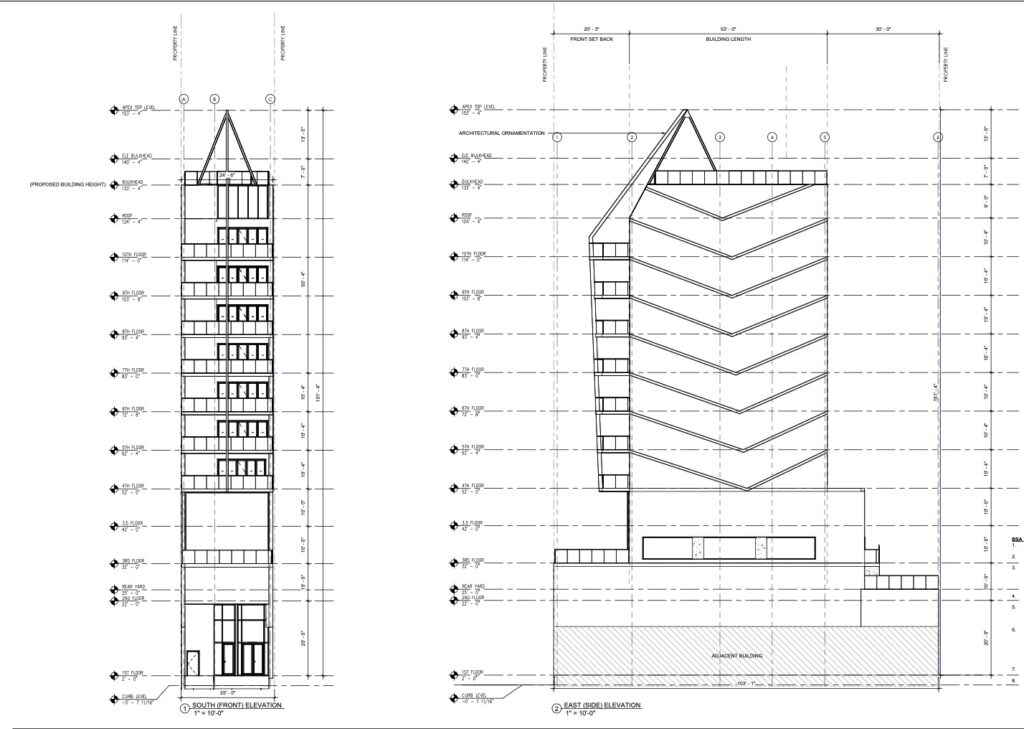
The Board of Standards and Appeals (BSA) will be holding its next hearing on a zoning variance to allow a luxury residential sliver tower at 51 Little West 12th Street on Tuesday, April 30th.
This tower would be located on the vacant lot on the north side of Little West 12th Street between the Brass Monkey and the High Line. The BSA has previously held two hearings on this application and has expressed a great deal of skepticism about applicant’s claim that he needs a residential zoning variance because of financial hardship due to unique conditions on this lot. The applicant has now further reduced the size of the proposed building to 9 stories and 134′ total height, but it is still way too tall.
If you are concerned about this inappropriate development in our community, here are two things you can do. First, write a brief message to the BSA asking that they deny this application.
Use this form on the BSA website:
Reference calendar # 2025-22-BZ, and use any or all of the points mentioned below.
Second, you can attend and speak briefly at the BSA hearing:
Tuesday, April 28th, meeting starts at 10:00 AM
Register to participate via Zoom here.
Instructions for participating in person or via zoom here.
This item is 3rd on the agenda, so I am guessing it will be heard in the late morning but it’s not possible to know for sure.
We believe the applicant has not met the criteria necessary to be granted a residential zoning variance in this Manufacturing (and commercial) District. These criteria include that the site has unique conditions that create an economic hardship to the developer (these conditions cannot be self-imposed), that the variance would not “alter the essential character” of the surrounding district, and that the applicant proves the requested variance is the minimum necessary to make a reasonable economic return on the property.
In your message, you can make some or all of the following points:
• The applicant argues that the site’s vacancy makes it unique. The vacancy results from a demolition order that the Department of Buildings issued in 2009 because the applicant’s building on the site was structurally unstable. The applicant claims this structural instability was caused by the construction of the adjoining Standard Hotel, and therefore was not self-imposed. However, the applicant has provided no evidence to support this claim, and the applicant has not explained the multiple DOB violations that indicate the structural instability was due to the applicant’s unpermitted and incomplete construction of a 4th floor on top of the building, and to inadequate maintenance.
• The applicant originally claimed that a residential variance would not alter the essential character of the district in part because 13 buildings in the district already contain residential uses. However, in response to information provided by Save Gansevoort the applicant now admits that 7 of these 13 buildings in fact contain no residential uses.
• The two primary BSA precedents that the applicant cites (at 128 West 26th Street and 132 West 26th Street) state that residential use variances were appropriate at these locations because the surrounding area was already highly residential (in fact, 40% of the sites within a 400′ radius were residential). This is simply not the case with 51 Little West 12th Street—the entire M1-5 district in which it is located is almost exclusively non-residential.
• The applicant’s Economic Analysis fails to account for the unique and extraordinary strengths of 51 Little West 12th Street’s location. It is directly across the street from the planned future entrance to the Whitney Museum, immediately adjacent to the High Line, one block from the Hudson River Park and Little Island, and across the street from the Gansevoort Market Historic District, one of New York City’s most fashionable landmark districts. None of the office or restaurant comparables on which the analysis bases its conclusions reflect the value of such a location.
• *IF* despite all of the above the BSA decides to grant the requested residential variance, it should insist that the visual obtrusiveness of the building be reduced. The height of the 20′ tall first floor and the 20′ tall third floor should be reduced. The large unenclosed space at the base of the tower should be enclosed, which would both add to the value of the ground-floor restaurant and reduce the amount of bulk available for the upper floors. The applicant should reconsider the need for mechanical space on the 2nd floor (which adds to the building’s bulk and height) and place these mechanicals within the huge bulkhead currently designed for the roof of the building.
Save Gansevoort has submitted additional written testimony to the BSA opposing this application. Please read it if you would like detailed information about our concerns.